
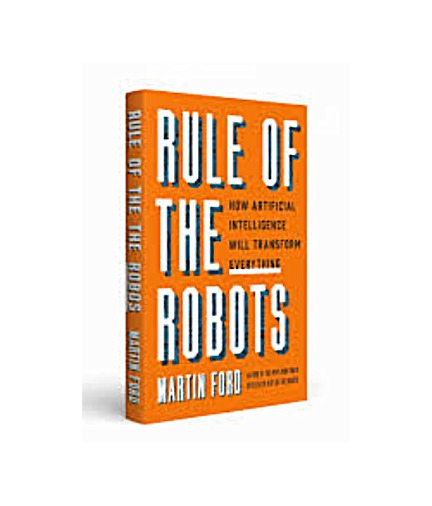
A review of Rule of the Robots: How Artificial Intelligence Will Transform Everything by Martin Ford
Reading a book about artificial intelligence published in 2021 is an interesting experience in 2026. Five years may not seem like much, but in the world of AI, it feels like an entirely different era.
I recently finished Martin Ford’s Rule of the Robots: How Artificial Intelligence Will Transform Everything. This is my second book by Ford, following Architects of Intelligence, which I reviewed earlier. While that book introduced me to the researchers and pioneers who helped shape modern AI, Rule of the Robots examines what their work might ultimately mean for our economy, institutions, and society.
What fascinated me most wasn’t simply Ford’s predictions. It was the opportunity to examine those predictions against what has actually happened in the years since he wrote them.
And my conclusion is somewhat paradoxical: Ford understood the transformative potential of AI remarkably well, yet underestimated how quickly the technology would advance while, in my view, overestimating the immediate severity of some of its economic consequences.
The Electricity of Intelligence
One of the most compelling ideas in the book is Ford’s description of AI as the “electricity of intelligence.”
I found this framing particularly insightful.
Electricity is not merely an industry. It is a foundational utility that powers virtually every other industry. We rarely stop to think about electricity when using a computer, operating a hospital, or manufacturing a car. It has become an essential part of modern civilization.
Ford argues that AI is heading in a similar direction.
Rather than remaining a specialized technology confined to research laboratories or technology companies, AI will increasingly become embedded in nearly everything we do. It will influence healthcare, education, transportation, finance, government, and countless other areas of human activity.
Five years after the book’s publication, this argument seems remarkably prescient.
AI is no longer something we merely discuss as a future possibility. We interact with it, work alongside it, and increasingly depend on it. The emergence of generative AI has brought sophisticated capabilities directly into the hands of ordinary people, often without requiring them to understand the underlying technology.
Ford was right about the direction of travel. What he couldn’t fully anticipate was how quickly the journey would accelerate.
A Future That Arrived Faster Than Expected
One of the most fascinating aspects of reading this book today is recognizing the technological environment in which Ford was writing.
In 2021, artificial intelligence was already making remarkable progress, particularly through deep learning and specialized systems. Yet the public had not experienced the generative AI revolution that would soon follow.
The transformer architecture had already been introduced in 2017, but its broader implications were not yet apparent to most people. The arrival of widely accessible conversational AI, followed by increasingly capable multimodal systems, changed public expectations almost overnight.
Suddenly, AI was not merely recognizing images, recommending products, or analyzing data. It was writing, reasoning through problems, generating software, interpreting documents, and interacting with people in remarkably natural ways.
What once seemed like capabilities that might emerge gradually over many years began appearing within a much shorter period.
This is where I believe Ford underestimated the speed of technological progress.
There is an important difference between anticipating continued improvement and anticipating a technological inflection point that fundamentally changes how people experience a technology.
Ford understood the trajectory. But even someone as knowledgeable about AI as he is could not fully predict the timing or consequences of that inflection.
That realization also reminded me of something broader….technological forecasting is difficult not necessarily because we misunderstand the underlying science, but because breakthroughs, adoption, and human behavior rarely follow a predictable timetable.
The Economic Disruption That Hasn’t Fully Arrived
Ford has long warned about automation’s potential to displace workers, concentrate wealth, and undermine the traditional relationship between employment and economic security.
These concerns deserve serious attention. I don’t dismiss them.
However, looking back from 2026, I believe he overestimated the immediate severity of some of these consequences.
Despite the extraordinary progress in AI capabilities, we have not witnessed the kind of widespread economic collapse or mass technological unemployment that some of the more pessimistic scenarios might suggest.
Instead, we have seen a complicated process of experimentation, adjustment, and adaptation.
Organizations are discovering that possessing a powerful AI tool is not the same as successfully integrating it into everyday operations. Employees are learning new skills. Institutions are reconsidering workflows. Businesses are trying to determine where AI genuinely creates value and where human involvement remains essential.
None of this means significant displacement will not occur in the future. It may. Certain occupations and tasks are already facing meaningful pressure.
But the relationship between technological capability and economic transformation is far more complicated than simply replacing one human task with one automated process.
And this brings me to an area where I find myself disagreeing with Ford’s underlying pessimism.
Humanity Is Not a Static Target
I believe Ford underestimated humanity’s institutional and psychological ability to adapt.
His economic analysis is compelling, but at times it seems to treat society as a relatively static target upon which increasingly powerful technology will act.
History suggests otherwise.
Human beings adapt. Sometimes slowly, sometimes reluctantly, and often imperfectly. Institutions resist change, then gradually accommodate it. New technologies eliminate certain activities while creating others. Entire professions evolve in ways that were difficult to imagine before the technology arrived.
The AI revolution is no exception.
What I have observed so far is not passive societal collapse, but rapid, messy, and surprisingly resilient adaptation.
This does not mean the transition will be painless or that its benefits will be distributed fairly. It certainly does not guarantee that every displaced worker will find an equivalent opportunity.
But I think we underestimate human ingenuity when we assume that technological capability translates directly into human obsolescence.
The future is shaped not only by what machines can do, but also by how people choose to use them.
AI Should Expand Human Potential
My perspective on this subject is influenced by more than reading books about artificial intelligence.
Through my professional work in information technology and my exploration of AI applications in the federal Judiciary, I have become increasingly interested in how intelligent systems can help people perform their responsibilities more effectively.
This is also the philosophy behind ALIJA, my ongoing exploration of trusted artificial intelligence for the Judiciary.
I do not view AI primarily as a replacement for human intelligence. I see it as an opportunity to augment it.
There are many things machines can do extraordinarily well: processing enormous amounts of information, identifying patterns, retrieving knowledge, performing complex calculations, and helping people work through difficult problems.
Why shouldn’t we use those capabilities to free human beings to concentrate on judgment, creativity, relationships, and responsibilities that require accountability?
Of course, augmentation does not happen automatically. It requires thoughtful implementation, training, appropriate safeguards, and a willingness to rethink established processes.
In an institution such as the Judiciary, the distinction between assisting human judgment and replacing it is especially important.
The objective should not simply be to automate as much as possible. It should be to improve the quality, accessibility, reliability, and efficiency of the services we provide while preserving human responsibility for consequential decisions.
To me, that is a much more promising vision than one in which humans and machines are locked in an inevitable competition for relevance.
What Ford Still Gets Right
Despite my disagreements with Ford’s assessment of the economic consequences, I believe his larger argument remains highly relevant.
If AI becomes a foundational utility, as he predicts, its effects will extend far beyond individual applications or industries.
It will raise difficult questions about economic opportunity, education, concentration of technological power, governance, accountability, and the distribution of benefits.
These are not problems that technology alone can solve.
And perhaps that is where Ford’s work remains most valuable. He encourages readers to think beyond the impressive capabilities of AI systems and consider the society we are building around them.
Even if the timing of certain predictions proves inaccurate, the underlying questions do not disappear.
In fact, as AI becomes more capable, those questions become more urgent.
My Personal Take
I enjoyed Rule of the Robots, particularly because I read it with the benefit of five years of extraordinary technological development.
Ford’s description of AI as the “electricity of intelligence” is the idea that will stay with me. I believe he correctly recognized that artificial intelligence would become a foundational technology, influencing nearly every aspect of modern life.
Where I differ from him is in my assessment of how humanity will respond.
Ford underestimated the speed at which AI would advance, but I believe he also underestimated our ability to adapt to that advancement.
The experience of the past several years has strengthened my conviction that AI’s greatest potential lies not in replacing human intelligence, but in expanding what human beings can accomplish.
That optimism is not a dismissal of the risks. Technological disruption, inequality, misuse, and concentration of power are genuine concerns. We need governance, education, responsible leadership, and institutions capable of responding to them.
But I remain optimistic about humanity’s ability to navigate this transformation.
Perhaps the greatest lesson I took from this book is that predicting what technology will become is only half the challenge. The other half is understanding what human beings will choose to do with it.
And that part of the future is still ours to shape.
AI Acknowledgment: This review reflects my own reading, reactions, and conclusions about the book. I used ALIJA, my customized AI assistant powered by ChatGPT, to help organize my reflections, refine the writing, and verify factual details where appropriate. The views expressed are my own.