
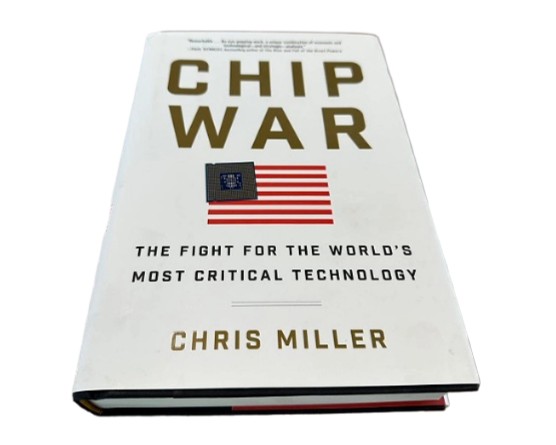
There are wars we see and then there are wars we don’t.
Chip War by Chris Miller tells the story of one such invisible conflict, one that doesn’t unfold on battlefields but inside laboratories, factories, and supply chains. It is a story about semiconductors — the tiny chips that power everything from smartphones to fighter jets — and how they quietly became the foundation of modern power.
I picked up this book expecting a technology story. What I found was something deeper: a history of innovation, competition, and the shifting balance of global influence.
Miller begins at the beginning — the invention of the transistor — and traces how a small scientific breakthrough transformed into the most important industry of our time. The journey through Moore’s Law, scaling, and relentless innovation is both fascinating and humbling.
What stood out to me was how much of this progress depended not just on intelligence, but on persistence and vision. The semiconductor industry didn’t evolve overnight. It required decades of experimentation, failure, and refinement — often led by individuals and companies willing to think long-term.
This part of the book reminded me that technology is not just about invention. It’s about discipline — the ability to keep improving something that already works, until it becomes indispensable.
What surprised me most was how the story shifted from innovation to competition.
The rise of Japan in the semiconductor industry, particularly in DRAM manufacturing, was eye-opening. Through a focus on quality control, manufacturing excellence, and strategic coordination, Japanese firms overtook American companies at a time when the U.S. industry was fragmented and, in some cases, distracted — even turning inward with lawsuits and internal competition.
This moment in history felt like a lesson in itself. Dominance is never permanent. It can be lost not only through external pressure, but through internal complacency.
Miller shows how the United States eventually regained its footing — not by returning to old models, but by evolving. The shift toward design (companies like Intel, Nvidia) and reliance on specialized manufacturing (like TSMC) created a new kind of ecosystem — one that is powerful, but also deeply interdependent.
Perhaps the most important realization from Chip War is how fragile the modern world actually is. We often think of technology as something stable — always available, always improving. But behind that illusion is a supply chain that depends on a handful of companies, specific regions, and highly specialized processes.
A disruption in one place can ripple across the entire global economy.
Reading this, I couldn’t help but think about how much of our digital life — including AI, cloud computing, and even national security — rests on this narrow foundation. Chips are not just components; they are leverage.
What makes Chip War compelling is how it connects technology to geopolitics without turning it into ideology. It shows, rather than tells, that control over semiconductors is now a form of power — as critical as energy or territory once was.
The rivalry between nations, particularly between the U.S. and China, is not just about trade. It’s about who will define the future of technology — and by extension, influence the global order.
Yet the book avoids alarmism. Instead, it presents a clear, well-researched narrative that allows the reader to draw their own conclusions.
What I appreciated most about Chip War is its clarity. Miller takes a highly complex subject and makes it accessible without oversimplifying it. The book reads smoothly, but it carries weight — the kind that stays with you after you’ve finished it.
For me, this wasn’t just a book about semiconductors. It was a reminder that the systems we depend on every day are built on layers of history, competition, and fragile balance.
If there is one thing this book reinforced, it is this: technology does not exist in isolation. It is shaped by people, institutions, and nations — each with their own ambitions, strengths, and limitations.
The story of semiconductors is not just about innovation. It is about discipline, strategy, and the ability to adapt.
As we move deeper into an age defined by AI and digital infrastructure, understanding the foundation — the chips themselves — becomes essential. Not just for technologists, but for anyone who wants to understand how the modern world actually works.
Because in the end, the most important battles are not always visible. Some are fought in silicon.
— Bidrohi