
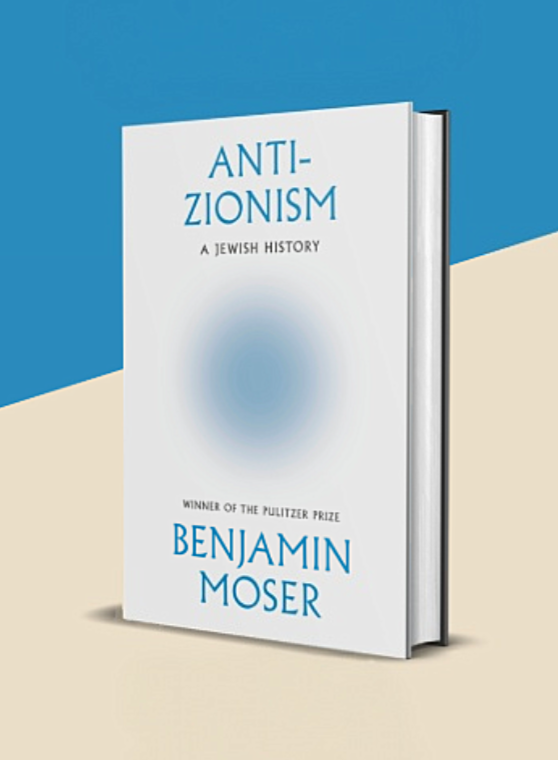
Having recently finished Molly Crabapple’s Here Where We Live Is Our Country and Omer Bartov’s Israel: What Went Wrong?, I approached Benjamin Moser’s Anti-Zionism: A Jewish History with a particular curiosity. What more could I learn about the historical relationship between Judaism, Zionism, and Jewish opposition to nationalism?
As it turns out, quite a lot.
Moser, a Pulitzer Prize-winning biographer, takes readers through more than a century of Jewish opposition to Zionism through the lives of twelve individuals. His book challenges the widely held perception that Zionism is an inseparable component of Jewish identity and that opposition to it is somehow a departure from Jewish tradition.
Instead, Moser introduces us to a longer and more diverse history of Jewish dissent, rooted in religious convictions, political philosophy, universal human rights, and moral conscience.
A History Beyond Eastern Europe
One of the most fascinating aspects of this book for me was its geographical and intellectual diversity.
Crabapple introduced me to the Jewish Bund of Eastern Europe and its belief that Jewish people could build meaningful lives, preserve their cultural identity, and fight for equality wherever they lived, without establishing a separate nation-state.
Moser takes this history in a different direction. He introduces religious thinkers, intellectuals, lawyers, and political activists whose opposition to Zionism emerged from remarkably different cultural and ideological backgrounds.
His exploration of early Orthodox Jewish pacifism was particularly interesting to me. The religious objections of Rabbi Aaron Samuel Tamares demonstrate that opposition to Jewish nationalism was not confined to secular socialists or political radicals. For some, it emerged from their understanding of Judaism itself.
The person I found most fascinating, however, was Jacob Israël de Haan, a Dutch Jewish poet, journalist, and gay man who embraced Orthodox Judaism. De Haan arrived in Palestine as a Zionist but eventually became an outspoken opponent of the Zionist leadership and an advocate for Arab-Jewish accommodation. His assassination in 1924 by a member of the Haganah is a disturbing chapter in the history of Jewish political dissent.
Equally compelling were the stories of Egyptian Marxist Ahmad Sadiq Saad and Felicia Langer, an Israeli human rights lawyer and Holocaust survivor who devoted much of her professional life to defending Palestinians in Israeli courts.
These individuals came from different countries, generations, and political traditions. They did not necessarily share a common vision of the future. What connected them was their willingness to challenge the political assumptions of their own communities.
Judaism, Zionism, and Jewish Identity
Perhaps Moser’s most important contribution is his effort to distinguish Jewish identity from political Zionism.
Judaism encompasses thousands of years of religious, cultural, philosophical, and ethical traditions. Modern political Zionism, by comparison, emerged in the late nineteenth century in response to a particular set of historical and political circumstances, including European antisemitism and persecution.
Understanding that distinction does not require dismissing the historical suffering of Jewish people or their legitimate desire for safety and self-determination. It does, however, challenge the assumption that support for a particular political ideology is a prerequisite for Jewish identity.
Moser presents Jewish anti-Zionism as a tradition with its own intellectual and moral history. His subjects remind us that Jewish life in the diaspora was not universally understood as an incomplete existence awaiting territorial redemption. For many, it was a meaningful expression of Jewish identity, belonging, and moral responsibility.
This is where I found an interesting connection between Moser and Crabapple. Although their books approach the subject differently, both reveal alternative visions of Jewish identity that existed before Zionism became dominant in much of Jewish political life.
Where I Question Moser
While I found much of the book compelling, I also have reservations about Moser’s approach to history.
Reading Moser after Bartov made their contrasting perspectives particularly noticeable. As I understood Bartov, Zionism contained both emancipatory aspirations and troubling contradictions from its early years, but its subsequent development was not necessarily inevitable. Historical decisions, political leadership, and missed opportunities mattered.
Moser appears far less open to the possibility that political Zionism could have developed differently. He seems to regard its fundamental contradictions as inherent in the ideology itself rather than as problems that might have been addressed through alternative historical choices.
I also found it surprising that the Jewish Bund did not receive more substantial treatment in a book devoted to the history of Jewish anti-Zionism. Having read Crabapple, I would have welcomed a deeper examination of this organized alternative to Zionist nationalism.
Similarly, I would have appreciated more critical examination of the political allegiances of some of Moser’s subjects, particularly those associated with Stalinism. Moral courage in opposing one form of injustice does not necessarily absolve an individual of supporting another.
More troubling are the criticisms of Moser’s historical accuracy. In his review for The New Yorker, Isaac Chotiner challenges several of Moser’s presentations of historical evidence concerning interactions between early Zionist movements and Nazi Germany. These are serious criticisms involving an extraordinarily sensitive period of human history and deserve careful consideration.
I do not believe that these shortcomings invalidate the entire book or diminish the moral courage of the individuals whose stories Moser tells. But they do serve as a reminder that historical scholarship must be held to a consistent standard, regardless of how sympathetic we may be to an author’s conclusions.
History should help us understand complexity, not eliminate it for the convenience of an argument.
The Relevance of the Book Today
Moser’s book is less concerned with providing a political or diplomatic solution to the Israeli-Palestinian conflict than with recovering a tradition of Jewish moral and political dissent.
In that sense, its significance is particularly evident in the aftermath of October 7, 2023, and the devastating war in Gaza.
For contemporary Jewish individuals who oppose Israeli government policies or question Zionism itself, Moser offers a historical sense of belonging. Their convictions need not be understood as a rejection of their Jewish heritage. They can also be understood as a continuation of debates that have existed within Jewish communities for generations.
Yet opposition to Zionism, by itself, does not answer the difficult questions surrounding the future of Israelis and Palestinians. Questions of political governance, mutual security, equal rights, self-determination, and peaceful coexistence remain.
I finished the book with a greater appreciation for the history of Jewish dissent, but not necessarily with a clearer understanding of how the present conflict might ultimately be resolved.
Perhaps that was never Moser’s intention.
My Personal Take
What I took away from Moser’s book goes beyond the historical debate over Zionism. It reinforces something I have long believed: moral conscience must supersede tribal, religious, and national loyalty. Our commitment to justice should not depend on the identity of the victim or the perpetrator.
The critical reception of this book also reminds me how fiercely contested that principle becomes when questions of survival, identity, and statehood are at stake.
I understand the historical fears that shaped the Jewish pursuit of security and statehood. The centuries of persecution, the horrors of the Holocaust, and the continuing reality of antisemitism cannot be dismissed or forgotten. Nor can the suffering of innocent Israelis and their families.
But when I look at what is happening to the Palestinian people today, I find it increasingly difficult to accept that Israel’s actions can be justified solely in the name of Jewish survival.
There is a fundamental difference between the legitimate pursuit of security and the justification of policies that deprive another people of their freedom, dignity, and basic human rights.
The right of one people to live in security cannot come at the expense of another people’s right to exist in freedom and dignity.
What I admire about the individuals Moser introduces is their willingness to question political convictions within their own communities. It takes moral courage to challenge others, but perhaps even greater courage to challenge one’s own.
That principle must apply equally to me, to Moser, and to everyone who claims to stand for justice. Sympathizing with an author’s moral argument does not require me to overlook weaknesses in his historical scholarship.
I would recommend this book, particularly to readers who believe that Jewish identity and Zionism are inseparable. However, I would also encourage reading it alongside other historical perspectives, including those of Crabapple and Bartov.
No single book should determine our understanding of a history this complex.
Ultimately, I am left with a question that extends far beyond Judaism, Zionism, Israel, or Palestine:
If our moral conscience demands justice only when injustice is committed against our own people, is it really justice we seek, or merely loyalty disguised as morality?
— Bidrohi
AI Acknowledgment: This review reflects my own reading, reactions, and conclusions about the book. I used ALIJA, my customized AI assistant powered by ChatGPT, to help organize my reflections, refine the writing, and verify factual details where appropriate. The views expressed are my own.