I came to America as a teenager, settled in the Midwest, and gradually built a life in a country that I came to call home. Over the years, I have experienced tremendous kindness, opportunity, friendship, and acceptance. America gave me the chance to pursue my education, build a career, raise a family, and contribute to the country I chose as my own.
But there is another part of my American experience that I have rarely written about.
Fear.
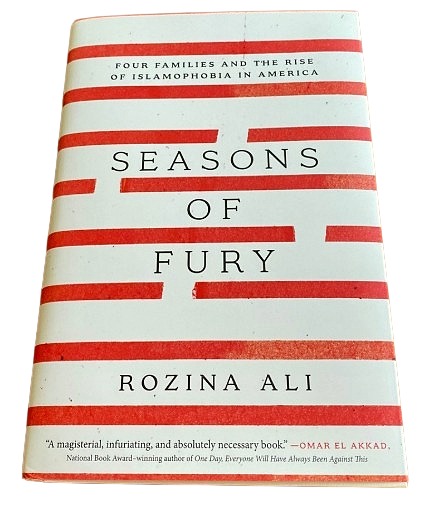
Not the kind of fear that comes from being physically attacked or openly threatened. Fortunately, I have never experienced anything remotely close to what the families in Rozina Ali’s Seasons of Fury: Four Families and the Rise of Islamophobia in America endured.
Mine was a quieter fear. An awareness that being Muslim in America could sometimes mean being viewed differently, particularly when something terrible happened somewhere in the world involving people who claimed to act in the name of Islam.
Reading Ali’s extraordinary account of four Muslim American families brought back memories I had carried for more than twenty-five years. It also helped me understand that the fear I experienced was part of a much larger American history—one that began long before September 11, 2001.
The Day I Will Never Forget
I remember September 11 vividly.
I was working as a network engineer for a large corporation. Like millions of Americans, I watched the horrifying images unfold on television. I could hardly believe what I was seeing. The destruction, the innocent lives lost, and the sheer cruelty of the attacks were beyond anything I could comprehend.
I was terrified by the thought that human beings could commit such an atrocity.
Then came another terrible realization.
The perpetrators were Muslims.
My heart started pounding. I felt ashamed, frightened, and deeply troubled. How could anyone commit such acts in the name of a religion whose teachings I understood so differently? This was not the Islam I knew, believed in, or practiced.
I was horrified by what had happened to my country. But I also began worrying about what might happen to people like me.
Would others look at me differently? Would my religion suddenly become more important to strangers than the person I was? Would I somehow be expected to answer for the actions of people I had nothing in common with except a religious label?
Something happened at work during those difficult days that I have never forgotten.
My boss called me into his office.
He told me that I was safe there. He assured me that if I ever felt threatened or needed anything, I should come to him. He even offered me his personal protection and a place to stay if necessary.
I cannot fully describe how comforting those words were.
He knew me. My colleagues knew me. I was their coworker and friend, someone they had worked alongside long before September 11. My boss did not see me as a representative of a religion that needed explaining. He saw me as a human being who might be frightened and needed reassurance.
That moment has stayed with me all these years.
Outside that familiar environment, however, I became more cautious. I paid greater attention to my surroundings. I was conscious of how people might perceive me. I heard stories from friends and followed news reports about what was happening to Muslim communities elsewhere.
I also remember hearing directly from students in our area about the registration requirements imposed on certain noncitizens from predominantly Muslim countries.
Still, I was fortunate. I never personally encountered the persecution, harassment, or devastating legal consequences described in Ali’s book.
And that difference is precisely what made reading it so emotional for me.
Four Families, One Troubling History
What makes Seasons of Fury remarkable is that Rozina Ali does not limit her investigation to the years following September 11.
Through the experiences of four families across several generations, she traces how suspicion of Muslims and Arab Americans became intertwined with American politics, foreign policy, law enforcement, immigration, and national security.
The stories are different, but their cumulative effect is powerful.
Abdeen Jabara’s experience takes us back to the 1960s and 1970s, when an Arab American attorney and political activist found himself under government surveillance. His story demonstrates that the institutional suspicion Ali examines did not suddenly emerge after September 11.
Mohammad Ali Chaudry’s story reveals another dimension. Here was a Pakistani immigrant who became a successful professional, participated in public life, and served as a mayor in New Jersey. Yet his community’s effort to establish a mosque encountered prolonged resistance.
Then there is the Omar family, whose names Ali protects. Their experience of persistent harassment by a neighbor is particularly disturbing because it takes place in the ordinary surroundings of American family life.
A home should be where a family feels safest. Yet the Omars’ experience shows how prejudice can transform even that basic expectation into a daily struggle.
As I listened to these stories, I kept thinking about how differently my own life unfolded.
I had supportive colleagues, good neighbors, and opportunities to succeed. These families also sought ordinary lives in America. Yet circumstances, institutions, and the people around them shaped very different experiences.
The question that stayed with me was simple: Why should the ability to live peacefully and feel protected depend so heavily on where someone happens to live, whom they encounter, or how authorities choose to perceive them?
Matin Siraj and a Mother’s Endless Struggle
Of all four stories, the one that affected me most deeply was that of Shahawar Matin Siraj and his mother, Shahina Parveen.
Siraj was a young Pakistani immigrant working in a bookstore in New York. He became involved in conversations with an undercover police informant about a possible attack on a subway station.
Ali’s reporting raises deeply troubling questions about the informant’s role, the vulnerability of the young man he cultivated, and the boundary between investigating a genuine threat and encouraging someone toward criminal conduct.
Siraj was convicted on terrorism-related charges and sentenced to thirty years in prison. No bombing occurred. His family has maintained that he was manipulated, and his case raises serious questions about entrapment and the methods used in counterterrorism investigations.
I understand that law enforcement has a responsibility to protect the public. After September 11, the fear of another catastrophic attack was real, and investigating credible threats was essential.
But protecting society and protecting constitutional rights should not be competing obligations.
I found myself wondering how far the government should be permitted to go in encouraging or facilitating a suspected plot before intervention becomes something fundamentally different from prevention.
Yet the legal questions were not what affected me most.
It was his mother.
Shahina Parveen’s years of struggle to free her son, her determination to challenge what she believes happened to him, and the burden of watching her family become associated publicly with terrorism were heartbreaking.
As a parent, I found that almost unbearable to contemplate.
We often discuss national security through statistics, investigations, arrests, convictions, and government policies. But behind those words are families. Parents. Children. People whose lives can be permanently altered by the decisions of institutions.
Ali makes us confront that human reality.
Whatever conclusions readers reach about Siraj’s legal responsibility, his mother’s suffering deserves to be understood.
When Fear Becomes Part of the System
One of the most important lessons I took from this book is that Islamophobia cannot be understood only through individual acts of prejudice.
An offensive remark, a hostile neighbor, or an act of vandalism may be visible manifestations of discrimination. But Ali asks readers to examine something less visible: the legal and political structures that can normalize suspicion toward an entire community.
Her account reaches back to surveillance of Arab American activists, through the expansion of counterterrorism laws and policies, and into the post-9/11 environment of registration programs, informants, immigration enforcement, and extensive monitoring.
I remember how frightened Americans were after September 11. I shared that fear. I wanted my country to be safe.
But reading Ali made me think about a difficult distinction.
When does legitimate concern about national security become generalized suspicion of people because of their religion, ethnicity, or national origin?
And once that suspicion becomes embedded in institutional practices, how difficult is it to reverse?
I also found myself thinking about other chapters of American history, including the treatment of Native Americans and Black Americans.
Their histories are distinct, and I would not pretend that the experiences are interchangeable. But they raise a recurring constitutional and moral question: What happens when the promise of equal protection is not experienced equally by everyone?
We often celebrate America’s founding ideals, and I believe those ideals deserve celebration.
But believing in those principles also means being willing to examine the moments when our institutions have failed to live up to them.
The Fear That Continues
I wish I could say that reading this book felt like revisiting a difficult chapter that America had already left behind.
I cannot.
The October 7, 2023, Hamas attacks and the subsequent war in Gaza brought renewed attention to questions of religious identity, antisemitism, anti-Muslim prejudice, Palestinian rights, and the relationship between international conflicts and American communities.
I condemn violence against innocent people, regardless of who commits it or whom it targets. I also believe that no American should be treated as responsible for the actions of a government, militant organization, or individual simply because of shared religion or ancestry.
Ali’s book made me more attentive to how political language, public fear, and institutional responses can affect people who have no connection to the violence being discussed.
I worry about what this means for the next generation.
My daughter has grown up with opportunities that I could only imagine when I first arrived in America. She has a great deal of life ahead of her, and I want her to experience this country with confidence, curiosity, and a sense of belonging.
Interestingly, I learned that Rozina Ali studied international relations and pursued journalism. My daughter studied journalism in high school and is now studying international relations herself.
That small connection made the book feel even more personal.
I hope her generation will continue asking difficult questions, studying history, examining institutions, and challenging assumptions—not because they should distrust everything, but because informed and thoughtful citizens are essential to a healthy democracy.
I want my daughter, and every young American, to inherit a country where no one feels compelled to prove their loyalty simply because of their faith or family background.
My Personal Take
Seasons of Fury is one of the most emotionally affecting books I have read in recent years.
Rozina Ali has done something important by bringing together four families whose experiences span decades of American history. Rather than treating Islamophobia as a collection of isolated incidents, she examines the institutions, political decisions, cultural attitudes, and historical circumstances that helped shape those experiences.
The story of Matin Siraj and Shahina Parveen will stay with me for a long time. But the greater power of the book comes from seeing all four families together.
Their experiences reminded me how fortunate I have been.
I came to America with hopes and dreams. I found people who welcomed me, trusted me, supported me, and gave me opportunities. My boss’s kindness after September 11 remains one of my strongest memories of that period.
I do not want that memory to be overshadowed by fear.
At the same time, I cannot allow my own positive experience to convince me that others did not suffer.
Both realities belong to the American story.
I believe deeply in this country and in the principles upon which it was founded. My career, my family, and much of my adult life have been shaped by those principles. Perhaps that is why I find the experiences in this book so troubling.
The Constitution promises religious freedom, due process, and equal protection of the laws. Those promises matter most when fear, anger, or political pressure makes them difficult to uphold.
I would encourage people to read this book—not only Muslims, immigrants, or those who have personally experienced discrimination. It is worth reading for anyone interested in American history, constitutional rights, law enforcement, national security, and the relationship between citizens and their government.
You do not have to agree with every interpretation Ali offers to recognize the importance of the questions she raises.
For me, the book ultimately comes back to something very personal.
I have spent most of my life in America. This is my home. I have never wanted anything other than to live peacefully, contribute to society, raise my family, and enjoy the freedoms this country promises.
And I want those same opportunities for everyone else.
Perhaps that is why the memory of my boss’s words still means so much to me.
At a moment when fear could have divided us, he chose kindness.
I hope that is the America we continue working to build.
AI Acknowledgment: This review reflects my own reading, reactions, and conclusions about the book. I used ALIJA, my customized AI assistant powered by ChatGPT, to help organize my reflections, refine the writing, and verify factual details where appropriate. The views expressed are my own.