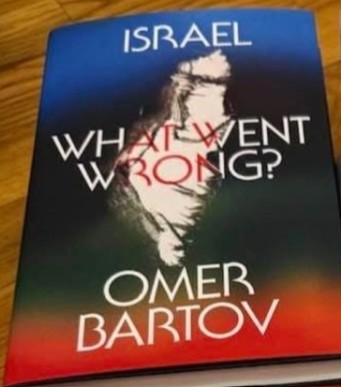
I picked up Omer Bartov’s Israel: What Went Wrong? because I wanted to understand Israel beyond the daily headlines.
Over the years, I have read and heard countless arguments about Israel, Zionism, Palestine, occupation, war, security, and terrorism. Most of those conversations quickly become political, emotional, and deeply divided. What I was looking for was something different. I wanted to understand the structure underneath it all: How did Israel become the country it is today? What ideas shaped it? What decisions were made at its founding? And how did those decisions continue to influence what came afterward?
Bartov gave me a perspective I had not fully understood before.
A Question I Had Heard Before
I had occasionally heard people ask a provocative question: If Israel is a country, where exactly are its borders?
I never completely understood what was behind that question.
Bartov helped me see that the issue is much more complicated than the question itself suggests. Israel is, of course, an internationally recognized sovereign state. But questions about its final borders, the territories occupied since 1967, settlements, Palestinian statehood, and the future political status of the land remain unresolved.
For me, however, an even bigger revelation was something I had not thought deeply about before: Israel does not have a single formal written constitution.
Israel instead developed a series of Basic Laws that today carry constitutional significance. But the constitution envisioned at the country’s founding was never completed.
That fact stopped me.
A constitution does more than establish government institutions. Ideally, it establishes the boundaries of political power and articulates the rights and responsibilities shared by everyone who lives under that system.
Bartov’s argument made me think about what happens when some of those foundational questions remain unsettled for generations.
Who belongs?
Who has equal rights?
Where does the state begin and end?
What does it mean to be both a Jewish state and a democracy containing citizens who are not Jewish?
Those questions are not simply academic. They reach directly into the political struggles Israel continues to face today.
The Two Faces of Zionism
Another aspect of Bartov’s argument that stayed with me was what I came to think of as the “two faces” of Zionism.
He does not present Zionism simply as an ideology that was destined from the beginning to produce today’s reality.
He recognizes its emancipatory origins: a movement emerging in a Europe where Jews had endured centuries of persecution, exclusion, pogroms, and eventually the Holocaust. The desire for safety and Jewish self-determination cannot simply be erased from the history.
But Bartov asks what happened afterward.
His argument, as I understood it, is that Zionism evolved. A movement seeking liberation and security for one persecuted people increasingly became entangled with ethno-nationalism, territorial expansion, and domination over another people.
That distinction matters.
If what exists today was inevitable from the beginning, then history becomes almost fatalistic. Nothing could have happened differently.
Bartov offers a more difficult argument: choices were made.
And if political choices helped create the present situation, different political choices could theoretically create a different future.
Connecting This Book With Another
While reading Bartov, I kept thinking about another book I recently read: Molly Crabapple’s Here Where We Live Is Our Country, about the Jewish Bund.
The Bund offered a very different Jewish political vision.
Rather than believing Jewish safety required territorial nationalism, Bundists argued that Jews should fight for dignity, equality, cultural identity, and political rights in the countries where they already lived.
“Here where we live is our country.”
When I first encountered that idea, it fascinated me because it complicated the assumption that there was ever only one Jewish political response to persecution.
Bartov’s book deepened that understanding.
Jewish history contains competing ideas about nationalism, belonging, security, identity, and coexistence. Zionism itself has contained competing traditions. History often becomes much easier to understand when we stop imagining that the people living through it all agreed about where it should lead.
Reading these two books close together helped me see that complexity much more clearly.
Can the Direction Still Change?
Bartov is deeply critical of contemporary Israeli policy and of the direction Israeli society has taken. But what surprised me is that his argument is not entirely without hope.
He believes the trajectory can still be changed.
Among the ideas he discusses is a confederation model in which Israelis and Palestinians would have their own sovereign political entities while sharing the land in ways that permit movement and residence across it.
Whether such an arrangement is politically realistic today is another question entirely.
But I found the underlying principle interesting.
Perhaps the land does not ultimately have to belong exclusively to one people at the expense of another.
Perhaps two peoples whose histories have become inseparably connected to the same land must eventually find a political structure in which both can belong.
My Personal Take
Israel: What Went Wrong? did not give me simple answers. In many ways, it gave me better questions.
The biggest revelation for me was understanding how Israel’s missing formal constitution and unresolved borders are connected to much larger questions about national identity, citizenship, equality, democracy, and the Palestinian question.
It also helped me better understand Zionism historically.
I can understand why a people who endured centuries of persecution would seek security and self-determination. Understanding that history, however, does not require us to stop asking what happens when one people’s pursuit of security conflicts with another people’s rights, dignity, and aspirations.
That may be the most important thing I took from Bartov.
History is not predetermined.
Political movements evolve. Nations evolve. Laws evolve. And societies make choices about what they want to become.
The fact that choices made in the past helped create today’s reality also means that different choices remain possible for the future.
After reading Bartov, and after previously reading about the Jewish Bund, I came away with a deeper appreciation for just how complicated this history really is.
And perhaps understanding that complexity is where any serious conversation about the future has to begin.
-Bidrohi
AI Acknowledgment: This review reflects my own reading, reactions, and conclusions about the book. I used ALIJA, my customized AI assistant powered by ChatGPT, to help organize my reflections, refine the writing, and verify factual details where appropriate. The views expressed are my own.