
By Kim Wehle — Reviewed by Bidrohi
I have lived in the United States for many years, worked within the federal judiciary, and taken an oath to support and defend the Constitution. Yet I realized there was still much I wanted to understand—not just the words themselves, but the ideas behind them.
As a first-generation immigrant, I have always viewed the Constitution with admiration. It represents freedom, opportunity, and the rule of law. But admiration alone is not enough. If we are to appreciate what the Constitution protects, we must also understand how it works, why it was written, and how it continues to evolve.
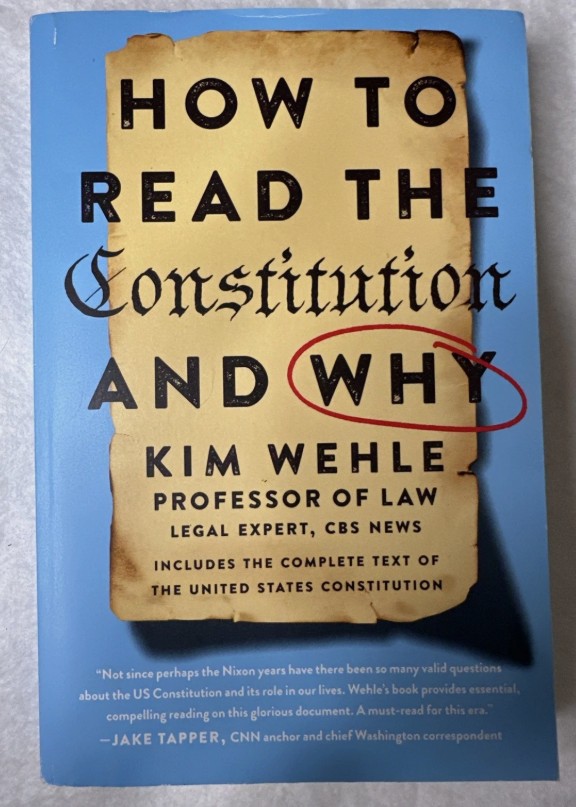
That is what drew me to How to Read the Constitution—and Why by Professor Kim Wehle.
This is not a book written only for lawyers or constitutional scholars. It is written for citizens. It explains how the Constitution came into being, why the framers structured the government the way they did, and how its meaning has developed through more than two centuries of interpretation.
What I appreciated most was that the book doesn’t treat the Constitution as a static document frozen in 1787. Instead, it explores the ongoing conversation between the Constitution, the courts, Congress, the presidency, and ultimately the American people.
Reading it gave me a much deeper appreciation for the balance our founders tried to achieve.
The separation of powers. The role of the three branches of government. The Bill of Rights. The constant tension between individual liberty and governmental authority. These are not abstract legal concepts. They shape everyday life, often in ways we don’t recognize until they are challenged.
One of the greatest strengths of the Constitution is that it established a framework rather than attempting to answer every future question. That flexibility has allowed it to endure for nearly two and a half centuries.
But flexibility also creates vulnerability.
As I read, I couldn’t help thinking about the gaps that inevitably exist in any constitutional system. Much depends not only on the words themselves but on the willingness of institutions to respect both the letter and the spirit of the Constitution. Checks and balances work only when each branch exercises its responsibilities independently and resists the temptation to accumulate power at the expense of the others.
That realization left me both appreciative and concerned.
The Constitution is remarkably resilient, but it is not self-executing. It ultimately depends on people—elected leaders, judges, public servants, and citizens—to preserve the principles upon which it was built.
One section of the book that especially caught my attention was the discussion surrounding the possibility of a constitutional convention.
The idea that the Constitution could be fundamentally rewritten is both fascinating and unsettling. Every generation seeks to improve the nation it inherits, but opening the entire Constitution for revision raises profound questions about what might be preserved, what might be changed, and what rights future generations could lose.
As someone who immigrated to this country and chose to become an American, I found myself reflecting on how much protection the Constitution has provided—not only for citizens born here, but also for those who came seeking opportunity, liberty, and equal justice under law.
In today’s political climate, where immigrants are often drawn into broader political debates, that protection feels especially significant. It also reminds me that constitutional rights should never be taken for granted.
Professor Wehle succeeds because she makes constitutional law accessible without oversimplifying it. She explains difficult concepts with clarity while encouraging readers to think critically about both history and current events. Whether one agrees with every interpretation she offers is almost beside the point. The real value of the book lies in helping ordinary citizens become better informed participants in our constitutional democracy.
My Personal Take
This book reminded me that the Constitution is much more than America’s highest legal document. It is a continuing promise—one that each generation inherits and must choose to preserve.
As a first-generation immigrant, I probably read this book differently than someone born here. I see the Constitution not only as the foundation of government but also as the foundation of the opportunities and freedoms that brought millions of people, including my own family, to this country.
That perspective also makes me recognize how fragile constitutional government can be. Rights exist because institutions defend them. Liberty survives because citizens understand it. And democracy depends not only on elections, but on an informed public willing to protect the checks and balances that prevent power from becoming concentrated.
One thought stayed with me long after I closed the book.
The Constitution belongs to every American—not just judges, lawyers, politicians, or scholars.
Perhaps the greatest civic responsibility we have is simply to read it, understand it, and pass that understanding to the next generation.
— Bidrohi