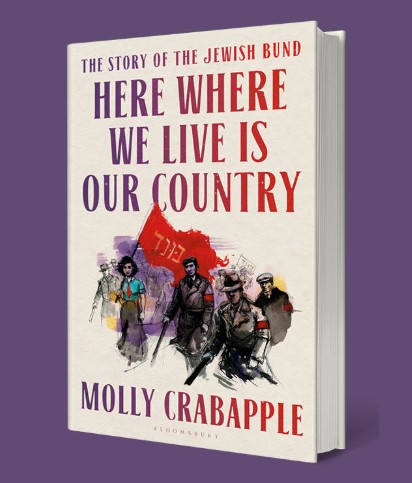
By Molly Crabapple — Reviewed by Bidrohi
Sometimes a book answers a question you didn’t know how to ask.
I picked up Where We Live Is Our Country by Molly Crabapple because I wanted to better understand Jewish history beyond the familiar narratives. Most discussions about Jewish identity eventually arrive at Israel and Zionism, often as if they were the only possible answers to centuries of persecution and displacement. I was curious whether other visions existed within Jewish history—other movements, other philosophies, other dreams.
What I discovered was the story of the Jewish Bund.
And it was fascinating.
The Bund emerged in Eastern Europe during a time of profound hardship for Jewish communities. It was a socialist movement, but it was also much more than that. At its core was a simple but powerful idea: Jews did not need to leave their homes to find dignity and security. They could fight for equal rights, justice, and cultural autonomy wherever they lived.
Their slogan became the title of this book:
“Where we live is our country.”
It is a phrase that stayed with me long after I finished reading.
In an age when nationalism often demanded separate states, separate identities, and separate destinies, the Bund offered a different vision. It argued that people should not have to abandon their homes, languages, neighbors, or communities to achieve freedom. Instead, they should struggle together with others to build more just societies where they already lived.
Reading about the Bund felt like uncovering a forgotten chapter of history.
Many people know about Zionism and the eventual creation of Israel. Far fewer know that large numbers of Jews once opposed that vision. The Bund believed Jewish survival and flourishing could be achieved without a separate nation-state. Their answer to anti-Semitism was solidarity, labor organizing, democracy, and cultural preservation—not territorial nationalism.
Whether one agrees with their conclusions or not, their perspective deserves to be understood.
What makes this story particularly moving is knowing what happened next.
The communities that nurtured the Bund were devastated by the Holocaust. Entire worlds disappeared. Cities, neighborhoods, schools, newspapers, and generations of activists were destroyed. Reading their story is therefore not just an intellectual exercise; it is an act of remembrance.
Throughout the book, I found myself reflecting on larger questions that extend far beyond Jewish history.
What does it mean to belong somewhere?
Can a people achieve security without nationalism?
Is identity rooted in land, culture, faith, language, or shared experience?
These questions remain relevant today.
One reason this book affected me so deeply is that it reinforced something I have long believed: history is rarely as simple as the stories we inherit. There are often alternative voices, competing visions, and paths not taken. The Bund represents one of those paths.
The book did not fundamentally change my views on Zionism or the Israeli-Palestinian conflict. If anything, it strengthened my interest in understanding the perspectives of those Jewish thinkers who envisioned a future based on coexistence rather than separation. The Bund’s experience serves as a reminder that Jewish political thought has never been monolithic. It has always contained debates, disagreements, and diverse understandings of identity and justice.
What I appreciated most about Molly Crabapple’s work was her effort to recover these forgotten voices. The book is clearly well researched and grounded in extensive conversations and historical sources. More importantly, it treats its subjects with dignity. Rather than reducing them to footnotes, she restores them to their rightful place in the historical conversation.
In doing so, she reminds us that history is not only about what happened.
It is also about what might have been.
My Personal Take
The greatest value of this book is not that it provides answers. It is that it broadens the conversation.
At a time when identity is increasingly tied to nationalism and political boundaries, the Bund’s message feels surprisingly relevant. “Where we live is our country” is more than a slogan. It is a challenge to think differently about belonging, citizenship, and community.
Reading this book left me with a sense of sadness for the world that was lost, admiration for those who struggled for dignity under impossible circumstances, and curiosity about how different history might have been had their vision survived.
Most of all, it reminded me that history is richer, more complex, and more human than the simplified narratives we often inherit.
And that alone makes this book worth reading.
— Bidrohi