
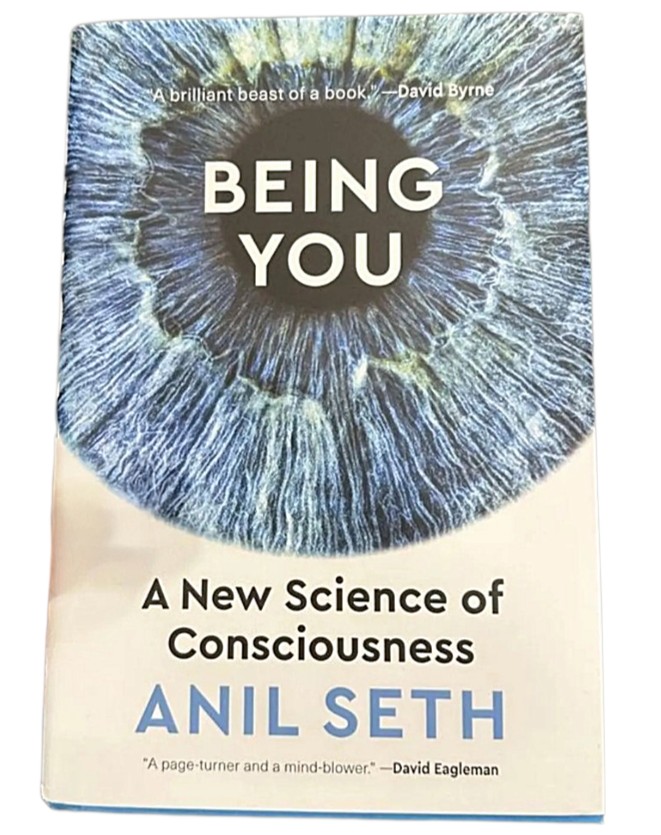
By Anil Seth
Few questions are as profound as this one: What does it mean to be conscious? Not simply to think or process information, but to experience the world—to feel, perceive, remember, and exist as a self.
I picked up Being You by neuroscientist Anil Seth with that question in mind, especially in the context of artificial intelligence and the growing conversation about machine consciousness. As we build increasingly sophisticated systems, it becomes natural to ask whether intelligence alone could someday produce awareness. Seth’s book attempts to answer that question from a scientific perspective.
What I found was both illuminating and incomplete, though perhaps incompleteness is inevitable when the subject itself is consciousness.
One of Seth’s central ideas is that consciousness arises from what he calls a “controlled hallucination.” According to this view, the brain does not passively receive reality; instead, it continuously predicts and constructs our experience of the world. Our perception is therefore a carefully regulated interpretation shaped by the brain’s expectations and the body’s sensory signals.
This idea is fascinating. It reframes perception not as a simple window into reality but as an active process of prediction and correction. The brain, body, and environment are deeply intertwined in producing the experience of being alive. Seth emphasizes that consciousness is not just a product of the brain in isolation—it is also tied to the body, our internal physiological states, and the continuous regulation of our biological systems.
In that sense, consciousness becomes something deeply embodied. It emerges from a living organism interacting with its world.
Reading this, I was reminded how different Seth’s approach is from the computational view presented by thinkers like Ray Kurzweil. Kurzweil imagines consciousness as something that could eventually be replicated through sufficiently advanced information processing. Seth is more cautious. For him, consciousness is not simply a matter of complex computation. It is a biological phenomenon grounded in the unique relationship between brain, body, and environment.
This distinction matters—especially as conversations about artificial intelligence become more ambitious.
The idea of machine consciousness fascinates many people today. Some see it as the next great technological frontier. Others fear it as a potential existential threat. Seth approaches the topic more carefully. He suggests that while machines may become extremely intelligent, replicating human consciousness may not be as straightforward as running the right algorithm.
Reading the book, I often felt that the scientific explanation, while impressive, stopped just short of something deeper.
Seth provides a compelling account of how perception and awareness may arise from neural processes. But consciousness still feels like more than a prediction machine. It carries a sense of self, meaning, morality, and awareness that seems difficult to reduce entirely to biology or mathematics.
For me, consciousness remains tied to something sacred in human existence. I believe our awareness is connected to creation itself—to something beyond neurons and signals. Science can illuminate the mechanisms of experience, but it may never fully explain why consciousness exists in the first place.
And perhaps that is not a failure of science, but a reminder of its limits.
The final chapter of the book was particularly interesting to me because it brings the discussion back to the modern moment—the rise of artificial intelligence and the temptation to believe that machines might one day become conscious beings.
There is something alluring in that idea. It reflects a human desire to transcend our biological limits, to recreate ourselves through technology. Yet the more we chase that possibility, the more important it becomes to remember our origins. We are biological creatures shaped by evolution, culture, and relationships. Our consciousness is rooted in life itself.
The exploration of consciousness is therefore not just a scientific project, but also a philosophical and ethical one.
As AI systems become more capable, questions about machine awareness will inevitably grow louder. Alongside those questions will come concerns about job displacement, social disruption, and even existential risks associated with powerful technologies. But the deeper question remains…. what does it mean to create intelligence without understanding the full nature of consciousness?
Being You does not claim to solve the mystery of consciousness, and perhaps no book ever will. What it offers instead is a thoughtful scientific framework for exploring how subjective experience may arise from living systems.
For readers interested in neuroscience, philosophy of mind, or the future of AI, this book is well worth reading. It encourages curiosity while reminding us that the most profound aspects of human existence may resist simple explanations.
The more we learn about consciousness, the more we realize how extraordinary it is simply to be aware—to experience the world, to question it, and to reflect on our place within it.
And that realization, more than any theory, may be the most important insight of all.
— Bidrohi