
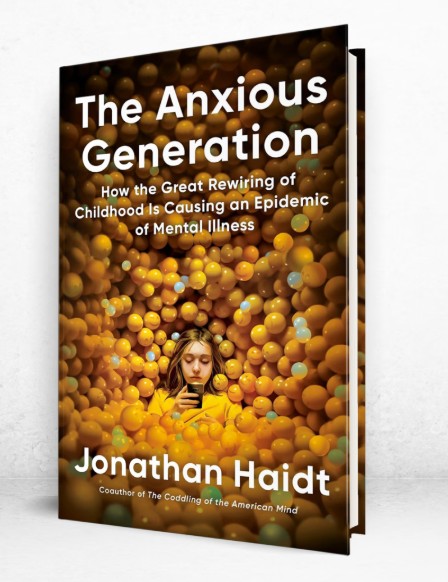
Some books inform you. Others unsettle you. The Anxious Generation does something quieter and heavier — it makes you look back. Not with regret exactly, but with the kind of awareness that comes only after something precious has already passed.
I read this book out of curiosity — wanting to understand what phone-based, internet-based childhood really does to a developing mind. My daughter has already passed adolescence. She’s grown into a thoughtful, beautiful young woman. Nothing in this book changes that. And yet, page after page, I found myself thinking: If I had known this earlier, I might have done some things differently.
From Play-Based Childhood to Phone-Based Childhood
Haidt’s central argument is simple and devastating: we replaced play with phones — and we did it without understanding the cost.
For generations, children learned resilience, empathy, and self-regulation through physical play: falling down, getting back up, negotiating rules, facing boredom, learning risk. Then, almost overnight, we moved childhood indoors and online. Screens became companions. Social media became the playground. Algorithms replaced human friction.
What Haidt makes clear — with data, not nostalgia — is that this shift coincides with a sharp rise in anxiety, depression, self-harm, and loneliness, especially among adolescents, and especially among girls.
This isn’t about weak children or inattentive parents. It’s about an environment that no human nervous system evolved to handle.
Reading as a Parent, Not a Critic
I didn’t read this book as someone judging parenting choices — including my own. I read it as someone trying to understand what we all walked into without a map.
Like many parents, I believed moderation would be enough. A phone here. Social media later. Balance, I thought, would naturally emerge. What Haidt shows is that balance is almost impossible when platforms are designed to capture attention, shape identity, and reward comparison — all during the most vulnerable years of brain development.
I found myself wishing I had been better prepared — not stricter, not fearful, just more informed. I wish I had understood earlier what a play-based childhood actually protects: not innocence, but mental health.
Girls, Identity, and the Weight of Constant Comparison
One of the most painful sections of the book focuses on girls. Haidt carefully explains why phone-based childhood affects them differently — and often more severely.
Social media turns identity into performance. Worth into metrics. Belonging into visibility. For a developing adolescent girl, this can be devastating. Anxiety doesn’t come from one cruel comment; it comes from never being free from the gaze of others.
Reading this as a father, I felt worry — not panic, but a deep concern for a generation growing up without silence, without privacy, without the relief of being unseen.
No Villains, Just Consequences
What I appreciated most about Haidt’s approach is that he doesn’t villainize parents, technology, or even the children themselves. He talks about systems — incentives, design choices, cultural shifts.
This isn’t a moral failure; it’s a societal blind spot.
We created an environment optimized for engagement, not development. And now we are asking children to adapt to something adults themselves struggle to manage.
Looking Forward in an AI-Shaped World
The book left me worried — not only about phones, but about what comes next. We are moving toward an even more digital world, increasingly shaped by AI. If screens alone can reshape childhood this profoundly, what happens when digital experiences become even more immersive, personalized, and persuasive?
Haidt doesn’t pretend to have all the answers. What he offers instead is something more valuable: clarity. He shows us where we went wrong — not to shame us, but to give us a chance to do better.
A Necessary Read, Especially for Parents of Young Children
If your children are still young — especially if you’re raising daughters — this book is not optional. It’s not alarmist. It’s protective.
I wish I had read The Anxious Generation earlier. I can’t change the past, but I can understand it better. And understanding, even late, is still a form of care.
My daughter turned out wonderfully — but this book reminded me that a healthier environment might have made her journey lighter. That realization stays with me.
My Personal Take
Reading this book didn’t make me feel like I failed as a parent. It made me feel like a parent who lived through a massive cultural experiment without informed consent.
We didn’t choose a phone-based childhood because we wanted anxious children. We chose it because we didn’t yet know what it would take away.
If there’s hope in Haidt’s work, it’s this: childhood can still be reclaimed. Play can still return. Boundaries can still be rebuilt — not out of fear, but out of love.
And maybe that’s the real message of this book: protecting children isn’t about controlling them. It’s about protecting the conditions under which they can grow whole.
— Bidrohi