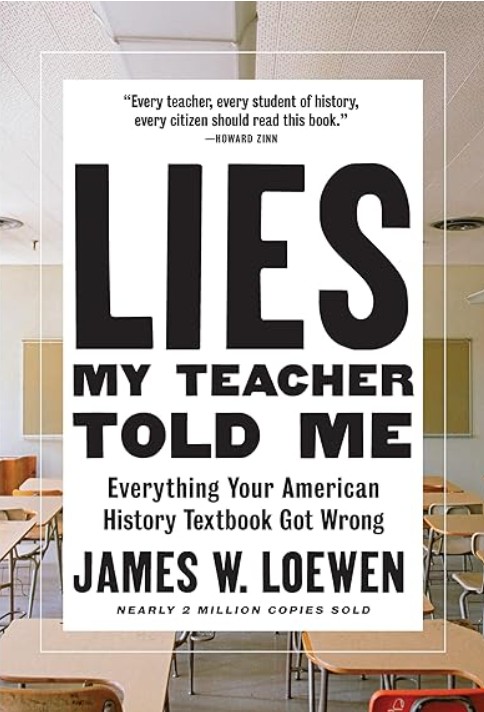
When you grow up outside America, you learn its story through a strange lens — part admiration, part myth. You’re told about liberty, invention, and the courage of explorers who “discovered” new worlds. What you don’t hear is the blood beneath those discoveries. Lies My Teacher Told Me shattered that lens for me — not because it was the first time I’d heard of deceit in history, but because it showed how methodical, how deliberate, that deceit has been.
Loewen doesn’t just write about what’s missing in American textbooks; he writes about what was removed — the conscious omissions that turn conquest into courage, oppression into destiny, and genocide into “manifest destiny.”
The Columbus Illusion
Like many of us raised under Western-influenced schooling, I too was taught to revere Christopher Columbus — a symbol of exploration, courage, and discovery. Even in Bangladesh, textbooks spoke of his voyage across the Atlantic as a triumph of human will. Only later did I learn what Loewen insists every student should know: that Columbus’s arrival marked not a discovery, but the beginning of destruction for millions of Indigenous people.
The sanitized version of Columbus — the visionary explorer guided by faith — hides the darker truth: enslavement, torture, forced conversions, and the deliberate extermination of native communities. Loewen exposes how textbook publishers and educators colluded, knowingly or not, in polishing Columbus into a national hero, teaching generations of children to celebrate cruelty disguised as courage.
What struck me most wasn’t just the moral bankruptcy of that lie, but how early children are taught to accept it — as if patriotism depends on ignorance.
The Half-Story of the Framers
Loewen also challenges the sacred aura surrounding America’s founding fathers. He doesn’t deny their achievements, but he refuses to let admiration excuse hypocrisy. These were men who wrote about liberty while owning other human beings, who spoke of equality while building a republic that excluded women, Indigenous people, and the enslaved.
He reveals how textbooks glorify them as near-saints — erasing the debates, the corruption, the racism, the self-interest. By simplifying history into good and evil, heroes and villains, education turns into indoctrination. What is lost is complexity — and with it, the honesty that makes a nation mature.
History as National Mythmaking
Reading this book, I realized how all nations — not just America — manufacture their own moral comfort. We edit our past to protect our pride. But in America, that process is industrialized. Loewen calls it a “heroification” — a social machine that turns flawed humans into flawless symbols.
He writes, “By making us feel good about ourselves, textbooks make it harder for us to learn from the past.” That line lingered with me. Because isn’t that the same impulse behind every empire’s myth — to write history not as truth, but as therapy?
Even outside America, we’ve lived under the shadow of these curated stories. In our own schooling, we were told that Columbus “brought civilization,” as though Indigenous cultures had none of their own. The deceit crosses borders because power exports its version of virtue.
Anger, and Then Appreciation
I won’t lie — parts of the book made me angry. Not just at the cruelty itself, but at how willingly history is polished to protect the perpetrators. There’s something unsettling about realizing that entire generations have been raised on half-truths — and that these distortions shape how they see justice, identity, and even other peoples’ suffering.
But alongside the anger, I felt gratitude. Loewen doesn’t write with rage. He writes with purpose — a calm, steady voice that trusts readers to think for themselves. He neither shames nor scolds; he invites. That’s rare in this age of outrage.
He reminds us that the goal of revisiting history isn’t self-loathing, but self-awareness. To admit that one’s nation has sinned is not betrayal; it’s maturity.
Truth as a Civic Duty
What I took from Lies My Teacher Told Me goes beyond America. It’s a reminder that every society tells stories that serve power — and that citizens, if they wish to remain moral, must learn to question them.
We can’t rewrite the past, but we can refuse to keep lying about it. We can stop rewarding silence and start honoring honesty. That’s the only way progress becomes real.
As I read, I thought about my own schooling, about how even far from these shores, we absorbed the same Western myths — the same “heroes,” the same one-sided tales. History, it seems, is not just written by the victors; it’s exported by them too.
A Book About Courage — and Correction
James Loewen’s gift is his balance. He doesn’t ask us to tear down heroes; he asks us to see them whole. He doesn’t argue for cynicism, but for accountability. That’s what makes this book so relevant today — when truth itself feels negotiable, and history is once again a battlefield of narratives.
If you’ve ever felt uneasy about the stories we inherit — whether about Columbus, the framers, or the myths of American virtue — this book will give your unease vocabulary. It doesn’t destroy your belief in a nation; it deepens your understanding of it.
Author’s Note
I read Lies My Teacher Told Me not just as an analysis of history, but as a mirror of our collective conscience. Every page asked: what truths have we traded for comfort?
In a world that rewards performance over reflection, Loewen’s courage is almost radical. He dares to tell the whole story, trusting that a nation strong enough to face its past is the only one capable of shaping a just future.
For me, this book wasn’t simply about America. It was about the universal danger of selective memory — the way every society crafts a story to feel righteous. The lesson is clear: truth isn’t what flatters us; it’s what frees us.
And freedom, like history, is never complete until it belongs to everyone — even those whose stories were erased.
— Bidrohi