
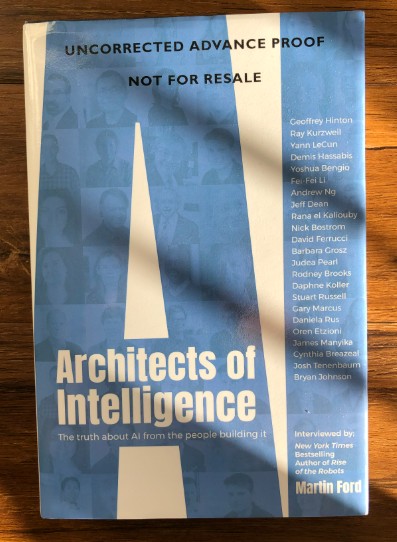
I didn’t pick up Martin Ford’s Architects of Intelligence randomly. It was actually recommended to me as I was preparing to begin my graduate studies in AI Leadership and Ethics.
I expected my early classes to take me through some of the history of artificial intelligence—where the field started, how we arrived at today’s generative AI, and where it might go next. I wanted to prepare myself by going beyond the technology I work with today and understanding the ideas and people that brought us here.
This turned out to be an excellent book for doing exactly that.
What makes Architects of Intelligence unusual is that Martin Ford doesn’t try to give us one grand theory of artificial intelligence. Instead, he interviews many of the people who helped create the field and lets them explain intelligence in their own words.
And those words don’t always agree.
That may be what I enjoyed most about the book.
Meeting Some Familiar Minds Again
After reading so many books about AI over the past several years, many of Ford’s interviewees already felt familiar to me.
I had encountered people such as Fei-Fei Li, Ray Kurzweil, Geoffrey Hinton, and Demis Hassabis through their books, research, interviews, or work. In some ways, listening to Architects of Intelligence felt like meeting people I already knew intellectually.
But there were others I knew much less about.
Judea Pearl, Yoshua Bengio, Rodney Brooks, Bryan Johnson, and several others opened different doors for me.
What fascinated me was the range of perspectives.
Some approach AI through neural networks. Others through robotics, language, logic, probability, neuroscience, economics, business, ethics, or philosophy. Some are interested in recreating aspects of human intelligence. Others question whether recreating the human brain should even be the objective.
The book reminded me that there is no single road toward artificial intelligence.
From Correlation to Causality
One discussion that particularly caught my attention was causality.
Modern machine learning is extraordinarily good at finding patterns and correlations in enormous amounts of data. But recognizing that two things are related is different from understanding why one causes another.
That distinction sounds simple, but it raises a profound question about intelligence.
Humans don’t merely recognize patterns. We constantly construct explanations of the world. We ask why. We imagine what might have happened if circumstances had been different. We reason about cause and effect.
That made the discussion of causality especially interesting to me.
It also connected with another subject I have been exploring through my reading: the human brain itself.
The more I learn about AI, neuroscience, consciousness, probability, language, and reasoning, the more fascinating the boundary between human and machine intelligence becomes.
And yet I don’t believe the goal needs to be creating a machine that is simply another human being.
AGI Feels Closer
I’ve read many books, research papers, and articles about artificial intelligence. Anyone who has followed my writing knows that I believe strongly in AI and its future.
This book strengthened that belief.
I am more convinced today that Artificial General Intelligence is closer than many of us once imagined.
Of course, nobody knows exactly when AGI will arrive—or even whether everyone will agree when it has arrived. But looking at the trajectory of the field and then listening to the people who helped create its foundations makes it difficult for me to believe that today’s systems represent anything close to the end of the journey.
We are still near the beginning.
But believing in increasingly capable AI does not mean I believe machines should replace people.
Quite the opposite.
Augmenting Human Intelligence
My vision for AI remains one of augmentation.
Machines are extraordinarily good at things humans are not.
They can perform complex calculations almost instantly. They can store and retrieve enormous amounts of information. They can analyze patterns across datasets no individual human could possibly read. Increasingly, they can execute complicated sequences of tasks toward goals that humans establish.
Why should humans spend our limited intellectual energy doing what machines can do better?
I would rather see AI take on more of that work and give humans something extraordinarily valuable in return:
Time.
Time to think.
Time to create.
Time to imagine.
Time to solve problems that require empathy, judgment, curiosity, wisdom, and creativity.
That philosophy is also why I have become even more confident in the idea behind ALIJA, the Artificial Legal Intelligent Judicial Assistant.
The objective was never to create an artificial judge.
It was to imagine an intelligent assistant capable of helping people navigate enormous amounts of legal information, perform research, retrieve knowledge, analyze information, and reduce repetitive intellectual labor—while leaving consequential human judgment with people.
The more capable AI becomes, the more powerful that model becomes.
A Different Question About Autonomous Weapons
One discussion in the book left me thinking long after I finished listening.
Several interviewees discussed autonomous weapons and the possibility of AI systems making decisions in warfare.
Much of that conversation understandably revolves around a frightening question: What happens when machines can independently identify and attack human targets?
But I found myself asking a different question.
Why do we assume that making warfare more intelligent means making weapons better at killing?
Throughout human history, military technological advancement has often meant finding more effective ways to destroy things and kill people.
AI potentially gives us something different.
What if an intelligent autonomous system were designed primarily to prevent people from dying?
Could AI disable weapons rather than people?
Could it predict escalation early enough to prevent a battle?
Could autonomous systems intercept or neutralize threats without destroying the humans behind them?
Could AI discover negotiating possibilities humans have overlooked?
Could it understand the incentives, fears, resources, geography, history, and possible outcomes of a conflict well enough to identify a path toward achieving legitimate security objectives without mass destruction?
I don’t know what those technologies would look like.
Perhaps nobody does yet.
But that is precisely why I think the question is worth asking.
If AI eventually becomes more capable than humans at solving extraordinarily complex problems, perhaps one of the problems we should give it is not simply how to win a war, but how to achieve security and resolve conflict while minimizing the need to kill.
That seems to me a much more ambitious use of intelligence.
My Personal Take
Architects of Intelligence was published before the generative-AI revolution transformed public awareness of artificial intelligence. Reading it today therefore creates an interesting experience.
We get to hear many of the people who helped build modern AI discussing where the technology might go before today’s AI systems became part of everyday life.
Some ideas have aged better than others. But collectively, the interviews reveal something important: today’s AI did not suddenly appear. It represents decades of competing ideas, experiments, failures, discoveries, and people trying to understand one of humanity’s oldest questions:
What is intelligence?
After finishing the book, I am more optimistic about AI than I was before. I am more convinced that AGI is approaching. And I am even more convinced that the future should not be about choosing between human intelligence and artificial intelligence.
We should be asking how the two can work together.
Let machines calculate, remember, retrieve, analyze, and execute.
Let humans imagine, create, question, empathize, judge, and decide what goals are worth pursuing.
And perhaps, as artificial intelligence becomes more powerful, we should challenge ourselves to give it goals worthy of that intelligence.
Not simply how to do what humans already do faster.
But how to help humanity do better.
-Bidrohi
AI Acknowledgment: This review reflects my own reading, reactions, and conclusions about the book. I used ALIJA, my customized AI assistant powered by ChatGPT, to help organize my reflections, refine the writing, and verify factual details where appropriate. The views expressed are my own.