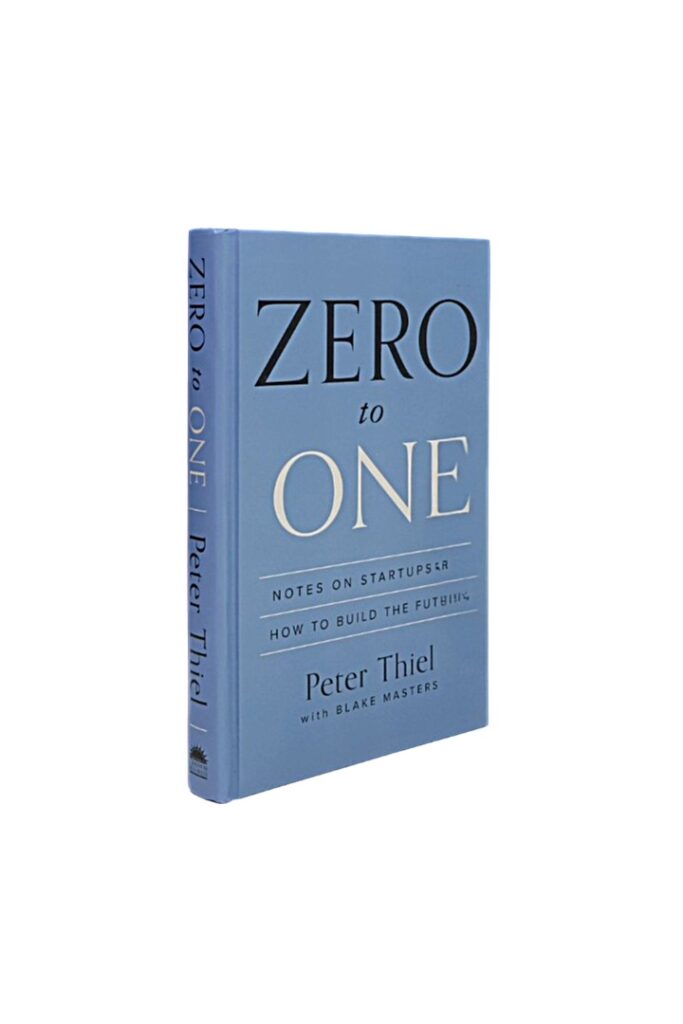
By Peter Thiel and Blake Masters
Some books don’t try to meet you halfway. Zero to One doesn’t soften its edges or seek consensus. It speaks with confidence, sometimes bordering on certainty, about how progress happens and who gets to shape it. I read it not as a startup manual, but as a glimpse into the mindset of Silicon Valley — how a certain class of builders think about innovation, power, and the future.
What resonated most with me was Peter Thiel’s emphasis on contrarian thinking and long-term vision. In a world that rewards imitation and short-term wins, his insistence that real progress comes from creating something genuinely new — moving from zero to one — felt refreshing. There is value in that challenge. It pushes us to question assumptions, to imagine futures others can’t yet see, and to resist the comfort of incrementalism.
At the same time, that clarity comes with a sharp edge. Thiel’s dismissal of competition and his embrace of monopoly unsettled me. He presents monopoly not as a market failure, but as a sign of success — the natural outcome of true innovation. Intellectually, I understand the argument. Competition can fragment focus and discourage long-term investment. But morally and socially, the framing feels incomplete. Power, once concentrated, rarely remains benign. The book spends little time wrestling with what monopolies mean for workers, institutions, or democratic accountability.
Reading Zero to One alongside books like The Alignment Problem or If Anyone Builds It, Everyone Dies, the contrast is striking. Where those works dwell on responsibility, alignment, and unintended consequences, Thiel is focused on dominance and durability. He sees technology primarily as leverage — a way to move decisively ahead, from zero to one, and then from one to many.
That view of AI, in particular, stood out to me. Thiel doesn’t treat AI as destiny or threat, but as a tool — powerful, yes, but valuable mainly for what it enables. In that sense, the book complements my recent readings. AI becomes an accelerant for vision rather than an existential force. Yet even here, something is missing. Tools don’t just extend capability; they reshape society. When AI is framed only as a competitive advantage, questions of alignment and ethics inevitably come second.
What Zero to One gave me most clearly was insight into how Silicon Valley often understands progress: build something unique, scale it aggressively, defend it fiercely, and control the future it creates. That worldview isn’t inherently malicious, but it is consequential. It explains why regulation is often seen as friction, why ethics are treated as afterthoughts, and why speed is valued over deliberation.
I admired the book’s conviction without fully agreeing with its conclusions. Vision is essential, but vision without accountability can harden into ideology. Innovation without humility can slide into extraction. Progress measured only in market terms risks losing sight of the human costs that don’t appear on balance sheets.
Zero to One is worth reading not because it offers a moral compass, but because it shows how many influential people navigate without one. It sharpened my understanding of how the future is imagined by those with the resources to build it. And that understanding, uncomfortable as it may be at times, is necessary.
Going from zero to one is an achievement. But the harder question — one this book largely leaves unanswered — is what responsibility comes with getting there.
— Bidrohi