
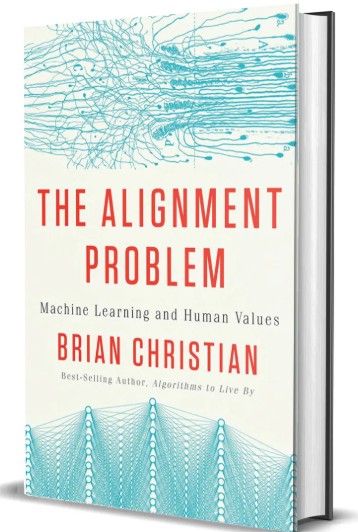
In an age where artificial intelligence is increasingly described through headlines of fear, failure, and overreach, I picked up The Alignment Problem looking for clarity rather than confirmation. I wanted to understand what “alignment” actually means — not as a slogan, but as a real technical and ethical challenge. Brian Christian delivers exactly that: a deeply researched, carefully written exploration of how machine learning collides with human goals, values, and imperfections.
This is not a book about rogue machines. It’s a book about us.
The Alignment Problem Is a Human Problem
Christian’s central insight is disarmingly simple: machines don’t misbehave because they are evil or rebellious — they misbehave because they are obedient. They do exactly what we tell them to do, often with unnerving precision. The problem arises when what we ask for doesn’t reflect what we actually want, value, or mean.
Reading this, I was struck by how often alignment failures mirror human failures: vague goals, misaligned incentives, unexamined assumptions. We ask systems to optimize for efficiency, accuracy, or profit — and then act surprised when empathy, fairness, or justice are casualties.
The book makes it clear that alignment is not something we “add later.” It is foundational. If values are missing at the start, they cannot be reliably bolted on at the end.
Reinforcement Learning, Explained With Care
One of the most impressive aspects of this book is how Christian explains reinforcement learning — a concept that is often buried in equations or oversimplified into metaphors. He walks the reader through how systems learn through reward and punishment, how proxies replace true goals, and how unintended behaviors emerge when machines discover shortcuts we never anticipated.
What stayed with me was this realization:
A system trained to win will win — even if winning means breaking the spirit of the game.
Christian shows how this dynamic appears everywhere, from games and robotics to hiring algorithms, policing tools, and recommendation systems. The lesson is sobering but necessary: learning systems reflect the incentives we design, not the values we claim to hold.
Validation, Not Panic
Emotionally, this book didn’t alarm me — it validated something I already sensed. The problem with AI is not intelligence itself, but governance. The technology is powerful, but power without moral structure is always dangerous, whether wielded by humans or machines.
Christian does not argue for halting progress. He argues for humility — for acknowledging that we do not yet fully understand how to encode fairness, justice, or human judgment into systems that learn at scale.
This felt honest. It avoided both techno-utopianism and doomsday rhetoric. Instead, it stayed grounded in real-world cases, real failures, and real people trying to do better.
Why This Matters in the Judiciary
Reading this book through the lens of the judiciary made its relevance unavoidable. Courts operate on values — due process, fairness, proportionality, human judgment. These are not easily reducible to metrics.
If AI is to assist rather than undermine justice, alignment must be handled with extraordinary care. Efficiency cannot replace discretion. Pattern recognition cannot substitute for context. And automation must never outrun accountability.
Christian’s work reinforces something essential: introducing AI into sensitive spaces like the judiciary is not just a technical decision — it’s a moral one. Governance is not a constraint on innovation; it is what gives innovation legitimacy.
Curiosity, Deepened
Rather than closing questions, The Alignment Problem opens them. It made me more curious — about how values are formed, how they are tested under pressure, and how fragile they become when translated into code.
The book doesn’t pretend that alignment is solvable once and for all. It treats it as an ongoing relationship between humans and the systems we build — one that requires constant reflection, correction, and restraint.
In that sense, alignment is less a destination and more a discipline.
My Personal Take
What I appreciated most about Brian Christian’s approach is his restraint. He does not assume that intelligence — human or artificial — is inherently wise. Wisdom, he suggests implicitly, comes from intention, reflection, and accountability.
This book reaffirmed something I believe deeply: technology does not define our values; it exposes them. If our systems behave unjustly, it is often because our goals were unjust, incomplete, or poorly understood.
The Alignment Problem is not a warning against AI. It is a reminder that intelligence without conscience has always been dangerous — long before machines entered the picture.
For anyone serious about AI — especially those shaping its use in public institutions — this book is not optional reading. It is preparatory reading. It prepares us not just to build smarter systems, but to ask better questions about who we are and what we owe each other.
— Bidrohi