
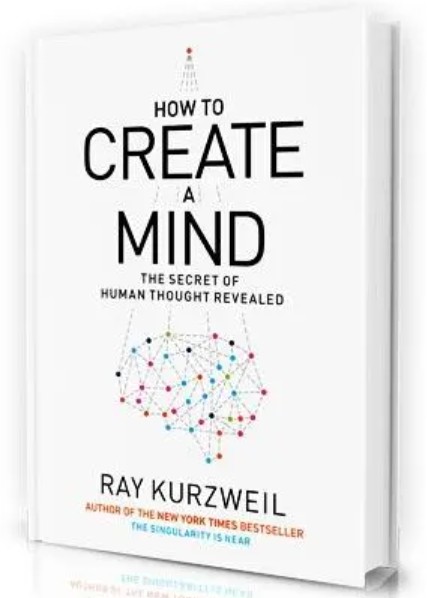
There is a certain kind of book that makes you pause—not because it is wrong, but because it is confident. Ray Kurzweil’s How to Create a Mind is one of those books. He writes with the certainty of someone who has spent a lifetime studying intelligence, convinced that the human mind is ultimately a system that can be reverse-engineered, replicated, and eventually improved upon.
I approached the book with curiosity, and I left with something more complicated. Fascination, yes. Appreciation, yes. But also, a quiet unease. Kurzweil offers a clear, elegant model of the neocortex—a hierarchy of pattern-recognizing modules stacked in layers that learn and predict. It is a beautiful idea. But sometimes beauty comes from simplicity, and simplicity can sit uncomfortably next to the truth.
The Neocortex, Simplified—Perhaps Too Much
Kurzweil treats the neocortex with a kind of engineer’s affection. To him, it is a clean architecture, a predictable machine whose principles can be mapped, modeled, and reproduced. Hierarchies. Patterns. Feedback loops.
But the more I read, the more I felt that he was describing only the surface of something immeasurably deeper.
Yes, our brains perform pattern recognition. Yes, intelligence emerges from structure. And yes, some parts of the mind—memory, prediction, even aspects of decision-making—may one day be replicated in software. But the human brain is not a neat hierarchy; it is a living universe, woven with emotion, intuition, moral awareness, and that strange spark that makes us more than what we can explain.
Kurzweil’s model thrilled me intellectually, but it also left me thinking: Is this really all we are? A pattern engine? A well-tuned algorithm?
I don’t believe it is.
Between Curiosity and Discomfort
There were moments in the book when I felt a kind of chill—not fear of the future, but of reduction. The idea that consciousness could be fully mapped and uploaded, that the soul is simply data waiting to be compressed, that the awe and mystery of human thought could fit neatly inside a diagram.
It is unsettling, but also strangely motivating. Because if nothing else, the book forces us to confront what we truly believe about ourselves.
Kurzweil believes that one day we will build a mind greater than our own.
I believe we will build astonishing machines—but not minds that mirror us fully.
There is a boundary he does not see or chooses not to honor.
Kurzweil sees human limitations as obstacles.
I see them as markers of the divine.
The Sacred Line Between Thought and Being
For me, reading this book was a reminder that intelligence is not the full measure of humanity. Kurzweil’s theories are brilliant, but brilliance does not equate to completeness.
I believe deeply that there is something sacred embedded within the human mind—an essence breathed into us, not engineered by us.
A machine may process patterns faster.
A machine may learn more efficiently.
A machine may even mimic emotion someday.
But consciousness, in its fullness—self-awareness, empathy, morality, wonder, the capacity to seek meaning and to know God—cannot be reverse-engineered. It cannot be uploaded, downloaded, or simulated.
It is not an emergent property of circuitry.
It is a gift.
And that is the line that no engineer, no matter how visionary, can cross.
Will We Create a Superintelligence? Probably. Will It Be Human? No.
Kurzweil imagines a future where machines surpass us intellectually and merge with us spiritually. I see a different future: one where machines become incredibly powerful tools—capable of great good or great harm—but always tools.
He speaks of a coming singularity.
I speak of a boundary that protects the soul.
Superintelligence may come.
But full human consciousness—rooted in grace, shaped by morality, capable of love and loss and longing—will remain uniquely human.
Not because machines are limited, but because humans are more than the sum of their neurons.
A Book Worth Reading—But Not Worshiping
How to Create a Mind is worth reading. It pushes you to think deeply about who we are and how we think. It forces you to confront the possibility that some parts of intelligence can be replicated—and the possibility that others cannot.
Kurzweil offers a map of the mind.
But the mind is not a territory that can be fully mapped.
The book left me with a stronger conviction:
Artificial intelligence may one day master logic, but it will never master the mystery of being human.
Not because we fail to build it, but because God built something in us that we cannot reproduce.
And that realization—more than Kurzweil’s diagrams, predictions, or theories—is what stayed with me after the final page.
— Bidrohi