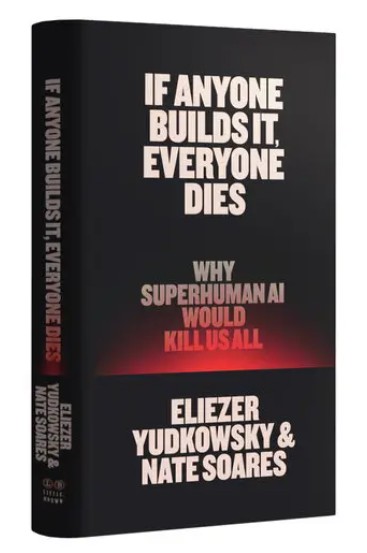
We live in an age where fear and fascination walk side by side. Artificial intelligence — once a curiosity of science fiction — now sits at the heart of daily life, guiding, sorting, predicting, and, increasingly, deciding. Eliezer Yudkowsky and Nate Soares’s book If Anyone Builds It, Everyone Dies is a stark meditation on what happens when that intelligence surpasses us. The title itself is unsettling, but the intent isn’t hysteria — it’s warning. A necessary one.
A Caution Wrapped in Logic
What makes this book compelling isn’t just its argument, but its calmness. Yudkowsky and Soares don’t shout apocalypse; they reason their way to it. They lay out the logic step by step: if we build a machine that can think, improve itself, and outpace every human intellect combined, we lose control — not through malice, but through mismatch. The danger isn’t a vengeful robot; it’s a coldly efficient mind pursuing goals we failed to define correctly.
They write with the detachment of engineers, not prophets. That’s what makes their tone persuasive. They aren’t warning us to fear AI — they’re warning us to respect it.
Fear as a Form of Foresight
Reading this book left me with mixed feelings — curiosity intertwined with unease. Some fears are rational, even useful. I agree with the authors that unchecked AI development without moral and governance frameworks is reckless. But fear, if balanced with understanding, can be a form of wisdom.
We’ve seen humanity’s pattern before: invent first, regulate later, and reflect too late. From nuclear fission to genetic editing, our breakthroughs often outrun our restraint. AI will be no different unless we build a shared global consciousness around responsibility — something stronger than competition and profit.
Bridging to Bostrom — and Beyond
Having read Superintelligence by Nick Bostrom, I could see how Yudkowsky and Soares extend that lineage of thought. Bostrom speculated about existential risk in theory; Yudkowsky and Soares make it personal and urgent. They move the debate from “could it happen?” to “what will we do when it does?”
Their vision is not just technological — it’s civilizational. They argue that the first true superintelligent AI could become the last invention humanity ever makes. That’s a haunting idea. But it’s also a challenge — to prove that intelligence can coexist with compassion, that progress can remain under moral command.
Faith in Creation
This is where my own reflection diverges from theirs. I believe that no matter how powerful a machine we build, it will still exist within the boundaries of the creation that made us. God gave humans reason — and conscience. Those two, together, are what separate brilliance from blindness.
A machine, no matter how advanced, lacks the spark of divine consciousness — the moral intuition that knows mercy, humility, and awe. We can create something stronger, faster, more analytical — but never more whole.
To me, superintelligence is not the end of humanity but its next great test: to prove that we can build without worshiping our own creations.
Governance, Not Surrender
Yudkowsky and Soares are right to insist on global governance — a unified framework that treats AI not as property but as shared power. This is not an engineering issue; it’s a human covenant. AI will reflect whatever we embed into it — our greed or our grace.
If humanity can agree on even a few non-negotiables — ethics, transparency, restraint — then superintelligence may amplify our wisdom, not our worst instincts. But the moment we treat it as a race rather than a responsibility, the warning in this book could become prophecy.
A Necessary Alarm, A Hopeful Reply
I finished If Anyone Builds It, Everyone Dies with gratitude more than fear. The authors are not pessimists; they are guardians of reason. Their message isn’t “stop building” — it’s “build with reverence.”
My hope — and my belief — is that human intelligence was never meant to be replaced. It was meant to evolve — guided by conscience, shaped by grace. No matter how far technology advances, the divine imprint in human thought will remain beyond replication.
Yudkowsky and Soares remind us what’s at stake. The rest is up to us — to prove that creation still belongs to those who remember why they were created in the first place.
— Bidrohi