
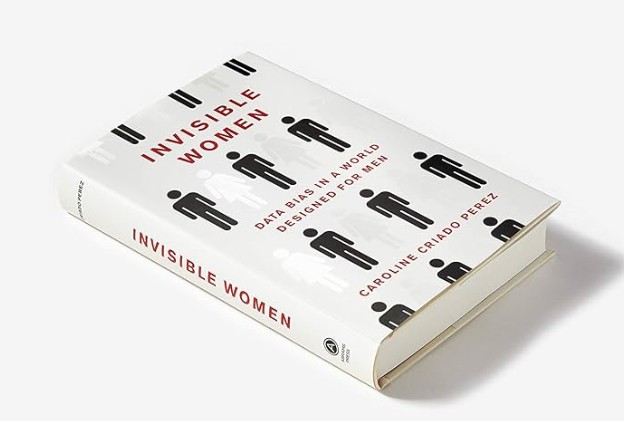
Caroline Criado Perez’s Invisible Women is a deeply researched and eye-opening look into how the world has been designed — often unintentionally, but sometimes willfully — around men, leaving women disadvantaged in nearly every aspect of life. She calls it the “gender data gap,” and once you begin to see it, it’s impossible to unsee.
Perez lays out example after example: from crash-test dummies based on the “average male body” that put women at greater risk in car accidents, to medical trials that excluded women, leaving doctors ill-equipped to understand female symptoms and risks. Even the design of phones, tools, and protective equipment ignores women’s bodies and needs. What emerges is a pattern of systemic oversight: when women are not counted, they are not considered — and when they are not considered, they are left vulnerable.
Reading this book was not just an intellectual exercise for me — it was personal. As the father of only daughter, I often think about her future in a world where data, authority, and power remain dominated by men. I don’t just see statistics in Perez’s book; I see barriers that my daughter, and countless other young women, will have to face if we do not change. The thought that policies, research, and systems continue to overlook half of humanity makes me both angry and determined.
Perez points to a mindset that runs through history: instead of asking how systems can better serve women, policymakers and experts too often ask, “Why can’t women be more like men?” Women are treated as the problem, rather than the systems built without them in mind. That quote from the book stuck with me because it captures the arrogance at the heart of the gender data gap.
For me, this book was both frustrating and energizing. Frustrating because the evidence is overwhelming: inequality isn’t just cultural, it’s built into the infrastructure, the policies, and the daily operations of our world. Energizing because Perez shows that the problem is solvable — if we start collecting data that includes women, and if we design systems that serve everyone, not just half the population.
As someone who works in technology, I also see parallels in my own field. Just as Perez highlights failures in medicine, transportation, and urban planning, IT systems and judicial technology risk reproducing the same blind spots. Equity isn’t only about good intentions — it’s about designing with inclusion from the start.
Invisible Women is more than a critique; it’s a call to action. It asks us to notice the gaps, demand better, and create systems where no one is invisible. As a father, I don’t want my daughter to grow up in a world where she is told to adapt to systems that were never built for her. I want her to live in a society where those systems are rebuilt with her in mind. Reading Invisible Women reminded me that this is not just possible — it is necessary.