
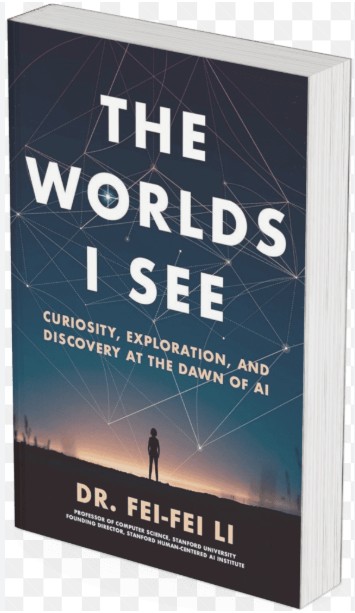
Here is another finished book: The Worlds I See: Curiosity, Exploration, and Discovery at the Dawn of AI by Dr. Fei-Fei Li. I didn’t read it as a technical history of computer vision, but as the story of a person learning how to look—closely, patiently, and with empathy—until the world starts to reveal its patterns. I came for AI; I stayed for the reminder that discovery is a human craft.
This isn’t a victory lap. It’s an immigrant family’s grind, odd jobs and long bus rides, a young scientist teaching herself to ask better questions, and a team trying to build something that didn’t exist yet. The middle chapters—where ImageNet takes shape out of spreadsheets, labels, mistakes, and stubbornness—felt especially honest. Progress doesn’t arrive as a breakthrough headline; it creeps in through small, repeated acts of attention.
What I appreciated most is how consistently the book returns to people. The science matters—the math, data, experiments but so do the hands that collect the data, the communities affected by the models, and the students learning to carry the work forward. Dr. Li makes “human-centered AI” feel less like a slogan and more like a practice: widen who gets to participate, name the risks, and build with humility.
There’s also a quiet lesson about scale. Big systems depend on unglamorous choices: naming things carefully, checking assumptions, documenting trade-offs. The book’s rhythm—observe, test, revise—felt like a good antidote to the hype that surrounds AI right now. Curiosity is not a sprint; it’s a habit.
I’ll keep The Worlds I See close, the way you keep a field guide. It’s a testament to curiosity, persistence, and the kind of leadership that makes space for others to see—and be seen. For anyone who wants to understand AI without losing sight of the people in the frame, this is a generous place to start.